
Sauerbraten is one of the most famous and iconic German foods in the world! And wow, you have bugged me one too many times to finally post my Rhineland-style Sauerbraten recipe (that is by the way already in my German cookbook)! I mean, I don’t blame you! Because this sweet-and-sour German pot roast is tender, deeply flavorful, and unlike anything you’ve probably had before. It’s comfort food with that fully honest German personality, and it proudly represents everything I love about German cooking.
This recipe is from my bestselling German cookbook 'German Home Kitchen.'
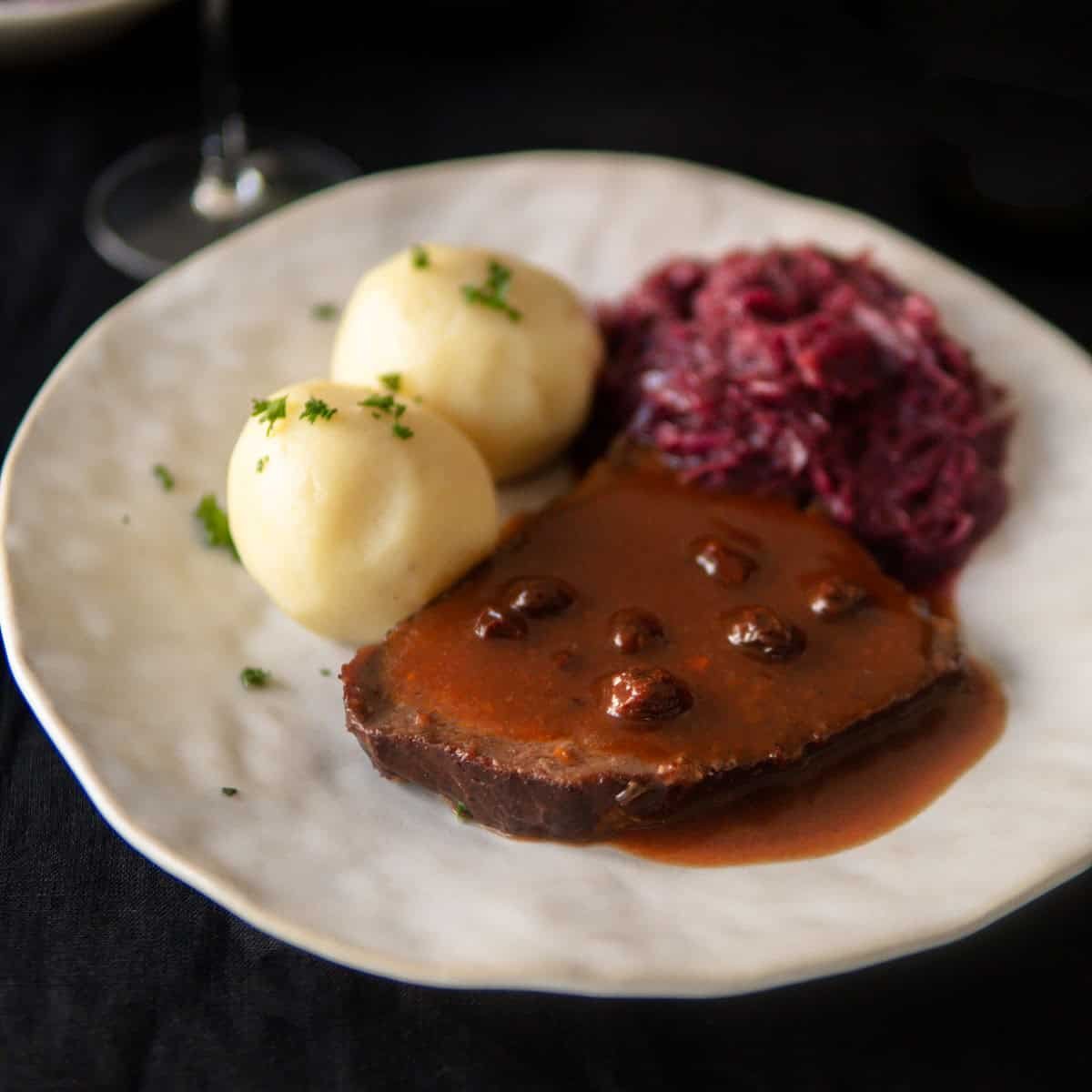
If you’ve ever had a version that felt too sour or too one-note, this recipe will change your mind. This is the Sauerbraten of my dreams: balanced, warm, aromatic, and gently sweet.
It’s hard to beat the sweet-and-sour combination in this roast and there really isn’t anything quite like it! And as a Trier-native who was always surrounded by Roman landmarks and history growing up, I loved learning that Sauerbraten has also been around since the Roman days. Romans used old preservation methods like marinating meat in vinegar to keep it from spoiling.
There are many ways of how to prepare Sauerbraten, but my favorite is with potato dumplings and German red cabbage. Usually this rather time-consuming roast I served at family gatherings and festive winter dinners. To me, it always felt like a special-occasion meal. And yet, once you understand how it works, Sauerbraten is surprisingly simple to make at home, even outside of Germany.
Traditionally, Sauerbraten uses a lean cut of meat that marinates for 3 to 5 days. This helps it to soak up the tang of the vinegar, warming spices, veggies, and red wine. Yes, that sounds long, but that time is what transforms a lean cut of beef into something incredibly tender and full of character.
By the way, if you're short on time (been there a few too many times), I’ll share a trick below that lets you shortcut the marinade down to as little as 1 to 2 days!
This authentic Sauerbraten recipe uses simple ingredients and clear step-by-step instructions so you can bring this German classic to your table with all the confidence you need!
Jump to:
Why it's the best Sauerbraten recipe
- It has perfectly balanced sweet-and-sour flavor
- Tender texture, even with lean cuts of beef
- Flexible marinating options (traditional AND quick method!)
- Authentic German flavor without complicated ingredients
- Foolproof instructions that guide you step-by-step
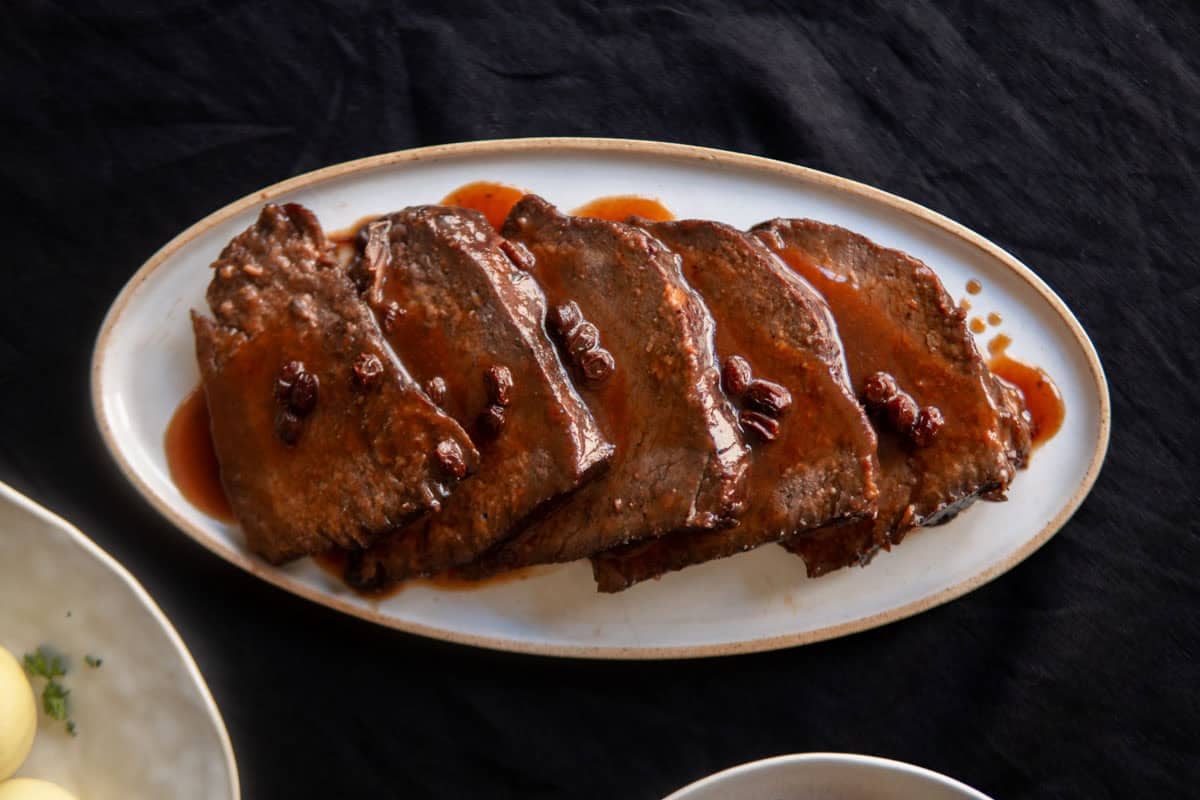
How to make it
For detailed step-by-step instructions, skip to the recipe card below.
Step 1: Make the marinade
Start by simmering together wine, vinegar, vegetables, spices, and sugar. This mixture becomes your marinade and the backbone of the entire recipe. Let it cool to room temperature before adding it to your beef.
Step 2: Marinate the beef for 3 to 5 days
This is the traditional way. The acidity breaks down the fibers, tenderizing even lean cuts like bottom round or rump roast.
If you have the time, go the full 5 days. It develops the deepest, most complex flavor.
Short on time?
There’s a trick from my German cookbook, ‘German Home Kitchen’, you can use:
Heat the wine and vinegar separately in a small saucepan to 200°F (93°C) before pouring them into the zip-top bag with the meat and remaining ingredients. This jump-starts the tenderizing process and brings your marinade time down to about 1 to 2 days. This is a lifesaver during busy holiday weeks and for busy moms like me!
Step 3: Sear and braise
Pat the meat dry, sear it in butter and oil, then braise it in the strained marinade and beef broth until perfectly tender.
Lean roasts are budget-friendly, but in order to get them tender, the combination of marinating and slow braising makes all the difference!
And if you can’t find a rump roast? Top round or arm roast also work beautifully. Another tip that I included in my book because certain cuts are harder to find in the U.S.
Step 4: Finish the sauce
Once the meat is cooked, the sauce gets sweetened with raisins and brown sugar. A cornstarch slurry thickens it and gives it that glossy, smooth finish that German gravies are known for.
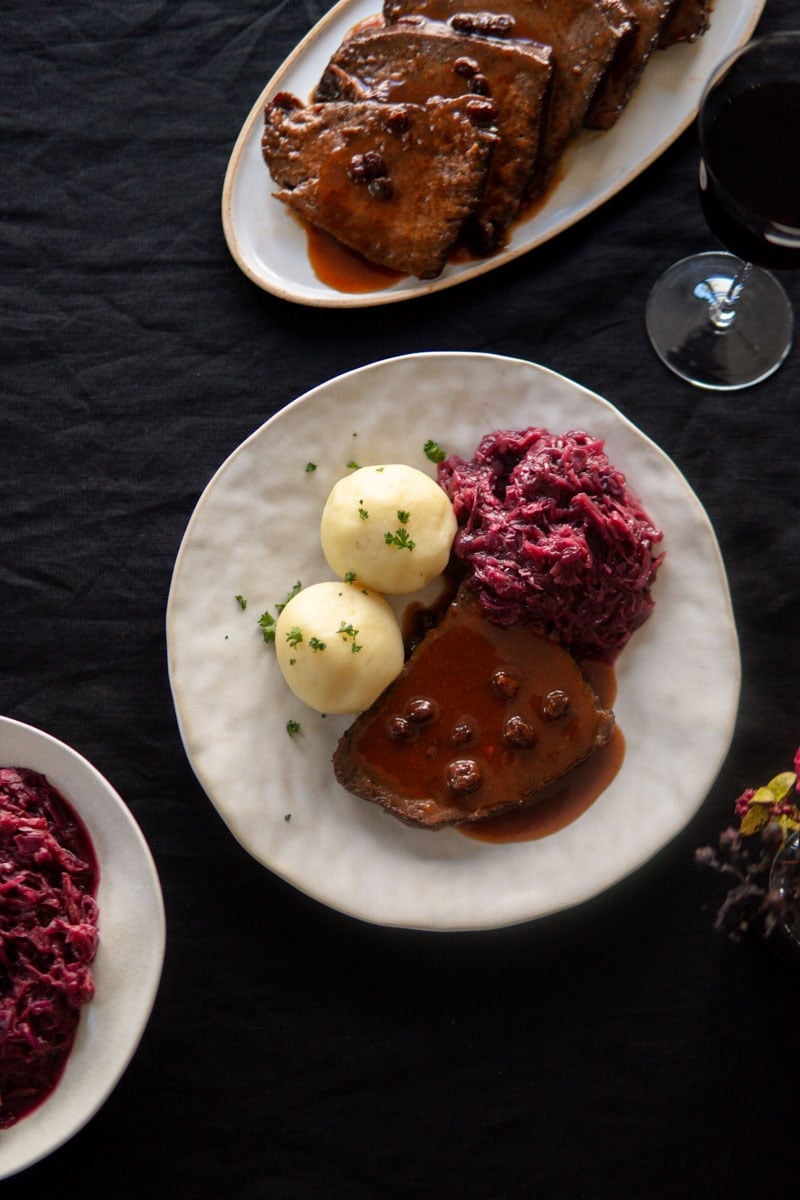
Serve immediately with Semmelknödel (bread dumplings) or Klöße (potato dumplings) or Spätzle (German egg noodles)and don’t forget the Rotkohl (sweet and sour red cabbage)! We even served our Sauerbraten with Käsespätzle before, and wow, what an experience!
Ingredients
All ingredients for making my traditional German Sauerbraten are easy to find in the United States. Let’s talk about them. For detailed ingredient amounts, skip to the recipe card below.
- Beef roast. Lean cuts like bottom round or rump roast are traditional. Alternative cuts you can use: top round or arm roast.
- Whole spices. Allspice, juniper berries, cloves, and peppercorns give Sauerbraten its warm and aromatic base.
- Vegetables. Carrots, celery, leek, and onion flavor both the marinade and the final sauce.
- Wine & vinegar. This duo creates the signature Sauerbraten tang. Use a dry red wine, such as Pinot Noir.
- Tomato paste & brown sugar. These bring balance, smoothing the acidity and enriching the gravy.
- Bread. The end slice of stale bread helps naturally thicken the braise and adds rustic flavor (a very old-school German trick).
- Raisins. They soften into the gravy, adding a subtle sweetness traditional to many regional Sauerbraten recipes.
- Beef broth. Combines with the marinade to create the braising liquid. I like using bouillon paste and water instead of using broth.
- Butter & oil. Used for proper browning, a very important flavor step.
- Cornstarch. Gives the sauce its glossy, luxurious finish and helps thicken it to the right consistency right before serving.
How to serve Sauerbraten
Serve this German pot roast with:
- Semmelknödel (bread dumplings) or Kartoffelklöße (potato dumplings)
- Spätzle or buttered egg noodles (or go the extravagant route and make Käsespätzle!)
- Rotkohl (German braised red cabbage)
- Also, try Speckknödel (bacon dumplings) or pretzel dumplings.
- A glass of dry German red wine, like German Pinot Noir
Sauerbraten tips (from my cookbook!)
- Quick Marinade Method: Heat the wine + vinegar to 200°F (93°C) first to reduce marinating time to 1–2 days instead of 3–5.
- Ask Your Butcher Ahead: Lean cuts like rump roast aren’t always stocked. Ordering ahead ensures you get the right cut.
- Use Top Round or Arm Roast: If rump roast isn’t available, these cuts still become beautifully tender thanks to the marinade.
- Rotate the Roast: If your meat isn’t fully submerged while braising, rotate it halfway through cooking for even tenderness.
- Taste the Sauce at the End: Adjust sweetness and acidity with extra brown sugar or a splash more vinegar. This is how German grandmas personalize it!
If you loved this Sauerbraten recipe, you will also love my German pork goulash, Goulash soup recipe, and Rinderrouladen (beef rouladen). Join my weekly free email newsletter for more German food inspiration or my membership ‘The German Connection’ to really dive deep into German cooking and baking.

Sauerbraten Recipe
Equipment
- 1 Mortar and Pestle or use a spice grinder
- 1 Dutch Oven or deep pan with a lid
Ingredients
Marinade (3 to 5 Days Ahead)
- 4 whole allspice berries
- 6 whole juniper berries
- 4 whole cloves
- 8 whole black peppercorns
- 1 kilogram lean beef roast such as bottom round or rump roast (see notes)
- 2 cloves garlic minced
- 2 medium carrots medium diced
- 1 large onion medium diced
- 2 celery stalks medium diced
- 1 large leek white and light green, parts halved lengthwise, rinsed and thinly sliced
- 2 bay leaves
- 1 teaspoon dried thyme or 1 tablespoon chopped fresh thyme
- 480 milliliters red wine such as Pinot Noir
- 480 milliliters red wine vinegar
- 50 grams brown sugar plus more to taste
Day-of
- 15 grams unsalted butter
- 15 milliliters avocado oil
- 15 grams tomato paste
- 1 heel of stale bread
- 1 liter beef broth plus more if needed
- 40 grams dark seedless raisins
- 1 teaspoon cornstarch
- salt and ground black pepper
Instructions
- Using a mortar and pestle or spice grinder, grind the allspice, juniper, cloves, and peppercorns.4 whole allspice berries, 6 whole juniper berries, 4 whole cloves, 8 whole black peppercorns
- Rinse the beef and pat it dry with paper towels.1 kilogram lean beef roast
- In a gallon-size zip-top plastic bag, add the meat, ground spices, garlic, carrots, onion, celery, leek, bay leaves, thyme, wine, vinegar, and brown sugar; press out as much air as possible and seal the bag. Place the bag in a bowl just big enough to hold it (to prevent leaks and keep it upright). Marinate in the refrigerator for 3 to 5 days (longer marinating results in more tender, flavorful meat; if short on time, see the Notes).2 cloves garlic, 2 medium carrots, 1 large onion, 2 celery stalks, 1 large leek, 2 bay leaves, 1 teaspoon dried thyme, 480 milliliters red wine, 480 milliliters red wine vinegar, 50 grams brown sugar
- Preheat the oven to 320°F (160°C). Remove the meat from the bag and pat it dry with paper towels. Set a fine mesh sieve over a large bowl and strain the marinade. Reserve the liquid and the marinated veggies.
- In a large oven-safe pot with a lid, heat the butter and oil over medium-high heat until foamy, about 1 minute. Add the meat and sear on all sides, 1 to 2 minutes per side. Transfer to a large plate.15 grams unsalted butter, 15 milliliters avocado oil
- Add the strained vegetables and cook, stirring occasionally, until softened, about 5 minutes. Add the tomato paste and cook, stirring until fragrant, about 1 minute.15 grams tomato paste
- Return the meat to the pot. Add the bread, then pour in enough broth and reserved marinade (equal parts) to cover the roast two thirds of the way. Cover the pot and place in the oven; braise until the meat is tender but not falling apart, about 2 hours. (If the meat is extra lean, extend the cooking time by 30 to 60 minutes.) Rotate the meat halfway through cooking, adding more broth and marinade as needed.1 heel of stale bread, 1 liter beef broth
- Transfer the pot to the stove. Using tongs, transfer the meat to a carving board, cover it with foil, and let it rest for 15 minutes.
- With a carving knife, slice the meat, against the grain, ½ inch (about 1 cm) thick.
- Set a fine mesh sieve over a large bowl and strain the liquid. Return the liquid to the pot and add the raisins; simmer over low heat until the raisins have softened and added sweetness, about 15 minutes.40 grams dark seedless raisins
- In a small bowl, whisk the cornstarch and 1 tablespoon of water until no lumps remain. Stir into the sauce and cook, whisking occasionally, until thickened, 1 to 2 minutes. (For a thicker sauce, cook it slightly longer.) Season with salt, pepper, and brown sugar to taste. Return the sliced meat to the pot, or arrange it on a warmed platter and spoon the sauce over the top.1 teaspoon cornstarch, salt and ground black pepper
Notes
NOTES
- For quicker marinating, separate out the wine and vinegar and heat them in a small saucepan over medium-high heat until a thermometer reaches 200°F (93°C) before adding to the zip-top bag along with the other marinade ingredients. This helps cut down the marinating time to 2 days in the fridge.
- You can also use top round or arm roast. It’s best to call your butcher ahead of time for this one, as lean beef roasts aren’t common everywhere outside of Germany.




Sophie Sadler
I hope you love my Sauerbraten recipe from my cookbook as much as we do! By the way, the 1 day quick method works just great!! Sophie